

Historical analysis / Legends
Where did Alex’s influence lie between goals and assists?
We examine his league output by season alongside scoring honours and team trophies, placing his sustained Fenerbahçe career next to his work in Brazil.
Updated: 29 October 2026
What do we expect from a number ten?
Alex often brings a pass to mind. Yet a player who topped league scoring twice cannot be described through passing alone. He scored 19 in 32 appearances in 2006/07 and 28 in 33 in 2010/11. The latter rate of 0.85 per game is notable even among historic scoring seasons. The question is whether finishing displaced his creative role or complemented it.
He arrived in 2004 and left in autumn 2012. Nine season headings represent eight complete seasons followed by the beginning of another, not nine full campaigns. His final five appearances are not an equivalent performance window to the preceding season’s 33.
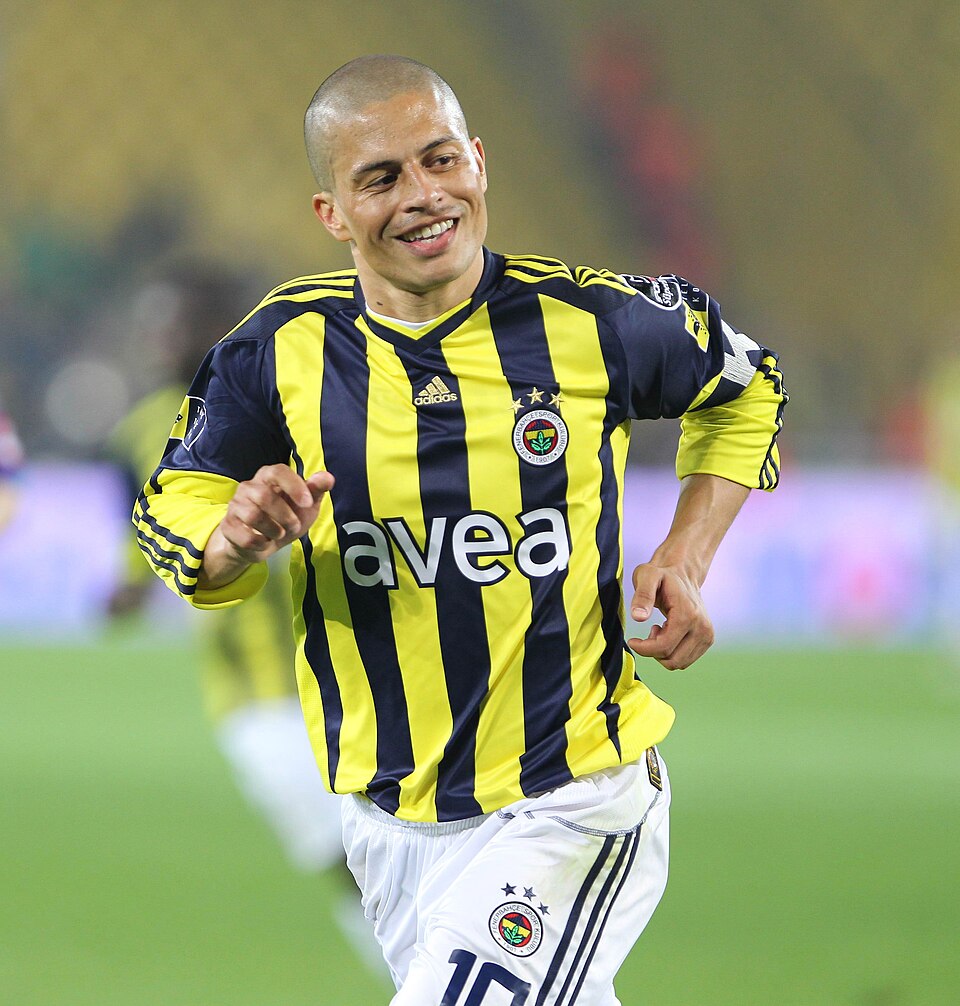
Photo information
Image record and usage information ↗- 1995Coritiba first team
- 2004Fenerbahçe
- 2007First Süper Lig scoring title
- 2008Champions League quarter-final
- 2011Second scoring title
- 2012Fenerbahçedeparture
The seasons were not identical
His first league season brought 24 goals, followed by 15 and then the title-winning top-scorer total of 19. He scored 11 in both 2008/09 and 2009/10 before reaching his Fenerbahçe peak of 28 in 2010/11. The pattern is not a continuous rise: his production recovered within changing teams and coaching arrangements.
Seasonal assist records use differing definitions, and some archives display missing values as zero. We do not interpret these as performance zeroes. The reported all-competition record of 344 appearances, 171 goals and 146 assists is identified separately, not as the league table’s assist total. The sum is about 0.92 goals plus assists per appearance within that reported scope.
Table values
| Season | Matches | Goals | Goals / match | Assists | Assists / appearance |
|---|---|---|---|---|---|
| 2004/05 | 31 | 24 | 0.77 | — | — |
| 2005/06 | 31 | 15 | 0.48 | — | — |
| 2006/07 | 32 | 19 | 0.59 | — | — |
| 2007/08 | 28 | 14 | 0.5 | — | — |
| 2008/09 | 26 | 11 | 0.42 | — | — |
| 2009/10 | 26 | 11 | 0.42 | — | — |
| 2010/11 | 33 | 28 | 0.85 | — | — |
| 2011/12 | 33 | 14 | 0.42 | — | — |
| 2012/13 | 5 | 0 | 0 | — | — |
Two playmakers · Turkish national league only
| Player · club | Matches | Goals | Goals / match |
|---|---|---|---|
Alex ·  Fenerbahçe | 245 | 136 | 0.56 |
Hagi ·  Galatasaray | 132 | 59 | 0.45 |
How does that production compare?
On the same league-only scope, Hagi scored 59 in 132 for Galatasaray and Alex 136 in 245 for Fenerbahçe: approximately 0.45 and 0.56 per appearance. Both creators supplied substantial finishing. Different team environments, penalty responsibilities and assist definitions prevent those two rates alone from settling who was better.
Set his 28-goal peak beside Aykut Kocaman’s 29 in 1988/89 and Hakan Şükür’s 38 in 33 appearances in 1996/97. Alex approached historic centre-forward totals while retaining a creative role. That does not rank him above every scorer, but helps explain why Fenerbahçe built so much attacking responsibility around him.
What did Fenerbahçe win?
His spell brought league titles in 2004/05, 2006/07 and 2010/11, the 2011/12 Turkish Cup and the 2007 and 2009 Super Cups. Both scoring titles coincided with championship seasons. Runners-up finishes in 2005/06 and 2009/10 show that individual output did not guarantee trophies; the 2007/08 Champions League quarter-final also matters beyond domestic honours.
His patience in waiting for a pass was sometimes read as slowing the game. Goals and assists cannot settle that debate without equally detailed off-ball and pressing data. Sustained finishing alongside creation nevertheless explains why describing him merely as an elegant passer is inadequate.
Before and after Istanbul
He developed at Coritiba and was part of Palmeiras’s 1999 Copa Libertadores winners. He captained Cruzeiro’s 2003 treble of the Minas Gerais championship, Brazilian Cup and Brazilian league. Fenerbahçe recruited a player who had already carried substantial attacking responsibility in a trophy-winning team.
He won the Copa América with Brazil in 1999 and 2004. After leaving Türkiye he returned to Coritiba and retired in 2014. The different stages highlight the same combination: a player capable of supplying the final pass and finishing the move. Sustaining both jobs was central to his Fenerbahçe value.