

Long-form analysis / League history
How did Bursaspor win the title in 2010?
Two final-day results decided the title. Bursaspor reached that point by combining their return against leading opponents with points across the rest of the league, without depending on one prolific scorer.
Updated: 29 October 2026
The final day was the outcome, not the explanation
Bursaspor’s title is often reduced to victory over Beşiktaş in Bursa and Fenerbahçe failing to beat Trabzonspor in Istanbul. Both mattered. But that leaves a larger question unanswered: how did Bursa remain a contender until the final day in a league containing Istanbul’s three giants and Trabzonspor?
We therefore compared the full season against common opponents. Bursa finished on 75 points to Fenerbahçe’s 74, with 23 wins each. The difference came from one fewer defeat and one more draw. That arithmetic alone does not explain the season unless we identify where those points were earned.
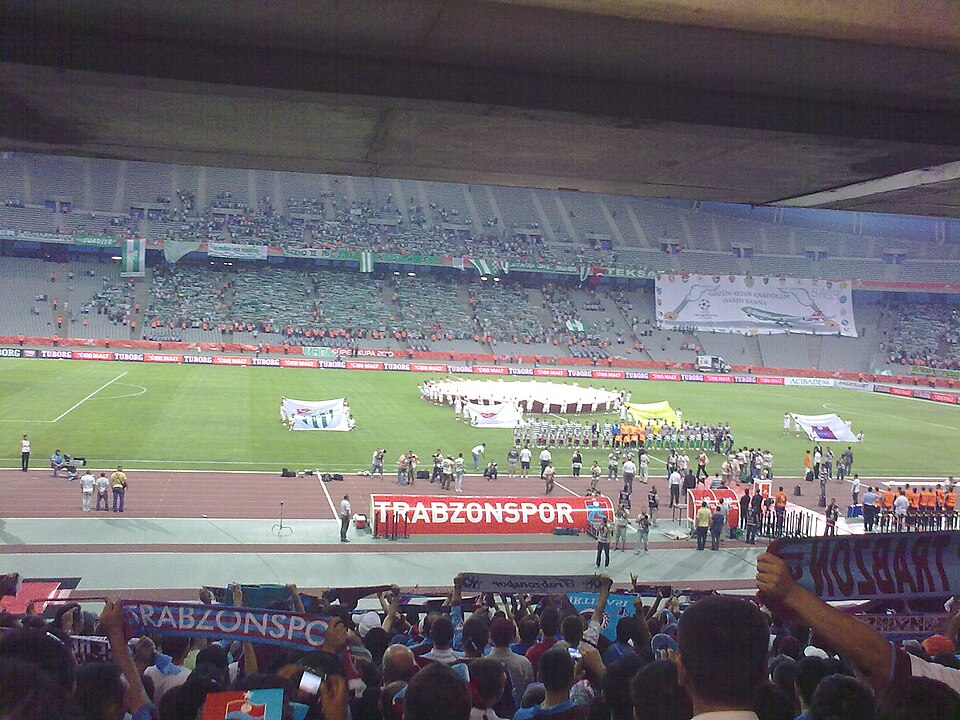
Photo information
Image record and usage information ↗Bursa did not avoid the big occasions
Bursaspor took 15 points from eight league matches against the traditional big four. They beat Beşiktaş twice, earned four against Galatasaray and two against Trabzonspor, and split the Fenerbahçe games. Recovering from 2–0 down to win 3–2 in Istanbul was particularly important because it took points directly from a title rival. This was not a challenge built only on beating weaker clubs.
The comparison needs equal opponents: Fenerbahçe cannot play itself, so its total against the big four would not cover the same eight fixtures. Against the three common clubs—Galatasaray, Beşiktaş and Trabzonspor—Bursa earned 12 points and Fenerbahçe 13 from six games each. The contenders also took three points each head-to-head. Bursa did not win the title by vastly outscoring Fenerbahçe in those fixtures.
Table values
| Opponent / group |  Bursaspor |  Fenerbahçe |
|---|---|---|
 Galatasaray | 4 | 6 |
 Beşiktaş | 6 | 3 |
 Trabzonspor | 2 | 4 |
| Against each other | 3 | 3 |
| The other 26 fixtures | 60 | 58 |
A small but decisive edge elsewhere
Removing the three common opponents and the head-to-head games leaves 26 fixtures each. Bursa earned 60 points and Fenerbahçe 58. A two-point advantage there overcame a one-point deficit against the common leading clubs. Bursa became contenders by competing with the established sides, then became champions by dropping slightly fewer points elsewhere.
Both clubs received two awarded victories against Ankaraspor: six points and six goals each. Those awards did not create the difference, but the official totals of 65 and 61 should not be described as goals all scored on the pitch. Removing the awards gives 59 and 55; Bursa’s four-goal advantage remains.
Complementary players rather than one dominant star
Ertuğrul Sağlam arrived during the second half of the preceding season, rather than in the title-winning summer. The campaign therefore combined an already familiar squad with new additions. Batalla, Ergiç, Turgay Bahadır, Hüseyin Çimşir and Zapotocny joined in summer 2009, while established players such as Ömer Erdoğan provided continuity.
We cannot reduce each player’s tactical contribution to a single number. The attack was clearly not dependent on one striker’s extraordinary total: Bursa did not provide the league’s leading scorer. Contributions from wide players, midfield and forwards worked together. Conceding 26 against Fenerbahçe’s 28 also gave a small defensive edge. The advantages in attack and defence were modest but complementary.
The final-day opportunity was earned beforehand
Fenerbahçe entered the final round one point ahead. Bursa beat Beşiktaş 2–1 while Fenerbahçe drew 1–1 with Trabzonspor. Without those results the trophy would not have gone to Bursa. Attributing the title only to a rival’s mistake ignores the 72 points already earned and the three that still had to be won.
The strongest explanation combines coaching continuity, complementary recruitment, remaining competitive against major opponents and a small points advantage across the other fixtures. That does not prove every similarly built team would become champions. It does explain more than calling 2010 a miracle: it identifies the footballing and points foundations that made the finish possible.